 |
||||
|
|
||||
|
|
||||
| Date Born: March 22, 1882 |
 |
Date Died: February 6, 1947 |
|||
| Place Born: Shelby, NC |
Place Buried: Sunset Cemetery in Shelby, NC |
||||
| Residence: Shelby, NC and Washington, DC |
Occupation: Lawyer |
||||
|
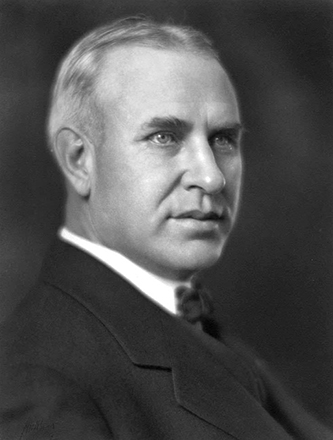
Oliver Maxwell Gardner was born on March 22, 1882 in Shelby, NC, the son of Dr. Oliver Perry Gardner and Margaret (Young) Gardner. He attended North Carolina Agricultural and Mechanical College (now NC State University) on a scholarship, where he majored in chemical engineering, was involved in ROTC, played on the football team, managed the baseball team, served as the senior class president, and maintained active membership in Sigma Nu Fraternity. Oliver Maxwell Gardner was selected by John Heisman, then coach at Clemson for his All-Southern team in 1903. He later taught organic chemistry on campus after graduating in 1903. He then enrolled at the University of North Carolina School of Law, where he also played football. He distinguished himself off the football field as well, becoming one of the most respected members of the Dialectic and Philanthropic Societies at University of North Carolina at Chapel Hill. Gardner was the only person ever to captain the football teams of both the University of North Carolina Tar Heels and the North Carolina State Wolfpack. On November 6, 1908, Oliver Maxwell Gardner married Fay Lamar Webb, daughter of James Landrum Webb and Kansas Love (Andrews) Webb of Shelby, NC; they had four children. In 1911, Oliver Maxwell Gardner was elected as one of two
men to represent the NC 33rd Senate District (Cleveland County,
Henderson County, Polk County, and Rutherford County) in the
NC Senate of the: In 1913, the NC Senate districts were re-apportioned due to the 1910 U.S. Census. In 1915, Oliver Maxwell Gardner was elected as one of two
men to represent the NC 32nd Senate District (Cleveland County,
Henderson County, Polk County, and Rutherford County) in the
NC Senate of the: In the 1916 general election, Oliver Maxwell Garnder was elected by the people as the next Lieutenant Governor of North Carolina, and he served under Gov. Thomas Walter Bickett from 1917 until 1921. In 1920, Oliver Maxwell Gardner lost the Democratic nomination for governor to Cameron A. Morrison. While temporarily out of politics, Oliver Maxwell Gardner pursued business interests, including a textile mill. In the 1928 general election, Oliver Maxwell Gardner was elected by the people as the next Governor of North Carolina. He served one term from January 11, 1929 to January 5 1933. Gov. Gardner assumed control over a state that was in debt and soon had to deal with the effects of the Great Depression. Gov. Gardner commissioned a report by the Brookings Institution on how to cut costs in government and cut local property taxes. Gov. Gardner pushed many of the Brookings Institute recommendations through the state legislature, including taking over financial responsibility for roads and schools from counties and the creation of what would become the consolidated University of North Carolina system. He reorganized and reformed the state government. Gov. Gardner took a pro-business, anti-union stance in a period of labor unrest, including the Loray Mill Strike. He did, however, push through the state legislature a workman's compensation law and successfully mediated a massive 1932 strike of mill workers in the Greensboro-High Point area. After leaving the governor's office, Oliver Maxwell Gardner practiced law and lobbied in Washington, DC. He was an informal advisor and speech-writer for President Franklin D. Roosevelt, who appointed him chairman of the advisory board to the Office of War Mobilization and Reconversion, and later a member of the Joint Anglo-American Commission on Palestine. President Harry S. Truman appointed him Under Secretary of the Treasury (1946–47). In 1947, Gardner was appointed by President Truman to be ambassador to the United Kingdom. Though, prior to ever arriving in London, Oliver Maxwell Gardner died of Coronary thrombosis at the St. Regis Hotel in New York City, NY on February 6, 1947. He was later buried in the Sunset Cemetery in Shelby, NC. Oliver Maxwell Gardner (22 March 1882 -- 6 February 1947) was the Democratic governor of the U.S. state of North Carolina from 1929 to 1933. Prior to becoming Governor, Gardner was elected as a state senator from Cleveland County, North Carolina (serving one term as President Pro Tempore of the North Carolina Senate) and as Lieutenant Governor of North Carolina (1917-1921). In 1920, he lost the Democratic primary runoff for Governor to Cameron Morrison. After leading North Carolina through the early years of the Great Depression as governor, Gardner practiced law in Washington, D.C. and was appointed by President Franklin D. Roosevelt chairman of the advisory board to the Office of War Mobilization and Reconversion and later a member of the Joint Anglo-American Commission on Palestine. He was appointed by President Harry S. Truman to be ambassador to the United Kingdom, but died before ever arriving in London. Gardner was part of the influential "Shelby Dynasty" or "Cleveland Dynasty" of related politicians, which included Governor Clyde Hoey. Gardner was the only person ever to captain the football teams of both the University of North Carolina at Chapel Hill and North Carolina State University. Raised in Shelby (Cleveland County) by his sisters after his parents died when he was young, Oliver Max Gardner won a scholarship to North Carolina State (A. and M.) College. Graduating in three-and-a-half years, he first taught chemistry in Shelby before studying law at the University of North Carolina. Upon getting his law degree, he began practicing law with his brother-in-law in Shelby. He served several sessions in the Legislature before, in 1916, being elected Lieutenant Governor. In 1929, he was elected Governor. His major focus areas were establishing voting by secret ballot, doubling the allotment to schools, creating a Tax Commission, and showing the farmers the advantage of raising foodstuff and livestock rather than relying for money on cash crops of tobacco and cotton. This latter project was called the "live-at-home program" and was the reason many North Carolina farmers survived the Depression. In the area of education, Governor Gardner achieved the consolidation of the colleges into the Greater University of North Carolina. The University of North Carolina of Chapel Hill, North Carolina State College in Raleigh, and the Woman's College at Greensboro were brought under one executive and one board. Governor Gardner cut the budget by degrees during the Depression and still accomplished improvements in prison conditions and abolished chain gangs. After his term as Governor, O. Max Gardner practiced law in Washington, D.C., was president of the Sperry Corporation, and was appointed ambassador to the Court of St. James. He never filled this prestigious position. He died on February 6, 1947, within hours of sailing to England to assume the post. Oliver Maxwell Gardner, governor of North Carolina, was born in Shelby, NC on March 22, 1882. His education was attained at North Carolina State College, where he graduated in 1903; and at the University of North Carolina, where he studied law. After establishing his legal career in his hometown of Shelby, Gardner became involved in politics. In 1908 he formed the North Carolina Young Men’s Democratic Club. He won election to the NC State Senate in 1911 and 1915, and was President of the senate in 1915. He also served as the Lieutenant Governor of North Carolina from 1917 to 1921; and was chairman of the state delegation to the 1924 Democratic National Convention. Gardner next secured the Democratic gubernatorial nomination, and was elected governor by a popular vote in the 1928 general election. During his tenure, a state tax commission was established; the state deficit was reduced; a secret ballot bill was sanctioned; and an office of relief was formed. After completing his term, Gardner moved to Washington, DC, where he practiced law. He also served as Chairman of the Advisory Board of the Office of War Mobilization in 1944; and was the Undersecretary of the Treasury in 1946. He then secured an appointment to serve as the U.S. Ambassador to Great Britain. However, he suffered a debilitating stroke, and passed away before taking his appointment. Oliver M. Gardner was buried in the Sunset Cemetery in Shelby, NC. |
|||||
| << Last Governor - Angus Wilton McLean | |||||
 |
 |
© 2007 - J.D. Lewis - PO Box 1188 - Little River, SC 29566 - All Rights Reserved