 |
||||
|
|
||||
|
|
|||
|
|
|
|
|
|
|
|
|
|
|
|
|
|
|
|
|
|
|
|
|
|
|
|
|
 |
|||
|
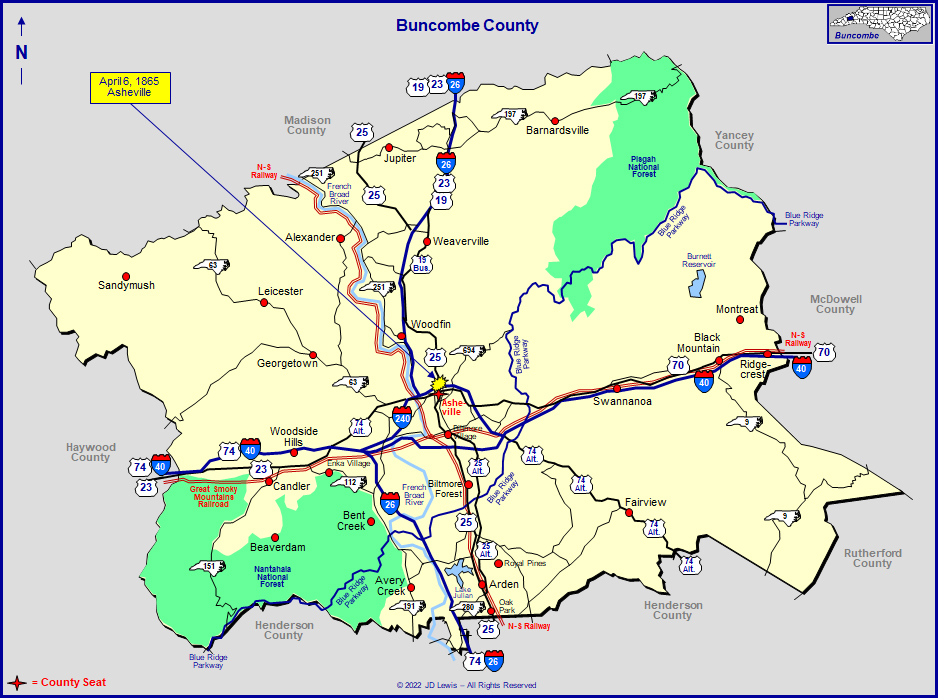
Known as the Battle of Asheville, this was a five-hour standoff on the northern outskirts of the town during the afternoon and evening of April 6, 1865. As of March 6, 1865, it appears that the severely diminished 62nd NC Regiment and 64th NC Regiment were consolidated under the command of Col. George W. Clayton. On March 10, 1865, Col. John B. Palmer's Brigade included the consolidated 62nd-64th NC Regiment and the 69th NC Regiment (7th Cavalry), and reported 440 officers and men present for duty. It is likely that there were about only 100 men who were considered with the 62nd NC Regiment since the regiment was so decimated at the Battle of Cumberland Gap. Union Col. Isaac M. Kirby, with guerrilla leader Col. George W. Kirk with a few mounted men dashed into the edge of Asheville, NC on April 6, 1865. Col. John B. Palmer with about 300-400 men and three field pieces of artillery managed to convince Col. Kirby and Col. Kirk that they were facing a much larger force than they had anticipated. A "heavy storm" broke, threatening to flood the French Broad River and the road which was their only retreat, so the Unionists started back for Greeneville, TN, with no men killed and only two men wounded, and capturing several Confederates. It can be stated that Col. George W. Clayton led the combined 62nd-64th NC Regiment, and the Confederates captured included QM. Sergeant Amos H. McAllister (Company D) and Private Alfred E. Edwards (Company I). On March 6, 1865, Brig. Gen. James G. Martin ordered that theseverely diminished 62nd NC Regiment and 64th NC Regiment be consolidated again, and finally, and would simply be known as the 62nd NC Regiment henceforth, under the command of Col. George W. Clayton of the 62nd NC Regiment. On March 10, 1865, Col. John B. Palmer's Brigade included the consolidated 62nd-64th NC Regiment and the 69th NC Regiment (7th Cavalry), with 440 officers and men present for duty. It is estimated that there were no more than 50 men from the original 64th NC Regiment now present. Union Col. George W. Kirk was ordered to Boone to prevent the Confederate Cavalry from pursuing Maj. Gen. George Stoneman. Col. Isaac M. Kirby's infantry brigade left Greeneville, TN with instructions to capture the town of Asheville, NC. His brigade reached Warm Springs on the morning of April 5th where he encountered "guerrillas" firing from the trees, so he sent his baggage back a ways and proceeded to Asheville, which he reached on the afternoon of April 6, 1865. Judging from reports that he had heard, Col. Kirby was of the opinion that the Southerners had between 1,000 and 1,500 men in Asheville, so he refused to enter the town. The Confederates came out with a very small line of battle, fired a few shots from their skirmish line, then fired a few rounds from a small field piece. Col. Kirby withdrew and returned to Greeneville, TN. Col. Kirby soon received a report that 300 Confederates were in his read near a vital bridge, when a "heavy storm" brok, threatening to flood the French Broad Road, his only line of retreat. According to civilian eye-witnesses, Col. Kirby left in a panic. Capt. Beverly T. Morris (writer of an earlier sketch) erroneously stated that Col. John B. Palmer led the Confederates and Maj. Gen. George Stoneman led the Federals, when the reality was that Col. George W. Clayton of the 62nd NC Regiment led the Confederates and Col. Isaac M. Kirby led the Federals at the "battle of Asheville." On April 13, 1865, Col. Isaac M. Kirby (U.S. Army, Army of the Cumberland, IV Corps, 1st Division, 1st Brigade, 101st OH Infantry) reported from Lick Creek, TN to Assistant Adjutant General (Capt.) Ed. D. Mason (U.S. Army) about his Expedition to Asheville of April 3-11, 1865. Highlights include: + On April 3, 1865, HQ of the IV Corps ordered him to go on
a "scout in the direction of Asheville, N.C." He departed
that same day at 2 p.m. with three (3) days rations in the haversack
and seven (7) in wagons, on the road leading by Midway Station,
across the Nola Chucky Creek at Allen's Bridge, striking the
Greeneville and Asheville road at a point ten (10) miles from
Greeneville; thence on that road to Paint Rock, a narrow pass
where the road strikes the French Broad River. |
|||
|
|
|
||
|
Col. George W. Clayton — Commanding Officer, Consolidated 62nd NC Regiment/64th NC Regiment — Col.
George W. Clayton, Macbeth Artillery (SC) (4 Guns) — Lt. B.A. Jeter. 69th NC Regiment (7th Cavalry) — Col. Robert L.
Coleman, 42nd NC Battalion-Home Guard (aka "Silver Greys) — Led by Unknown, Porter's Battery (2 Napoleons) — Led by Unknown. Total of about 300 men. |
Col. Isaac M. Kirby — Commanding Officer, Army of the Cumberland, IV Corps, 1st Division: 1st Brigade — Col. Isaac M. Kirby, - - - - - - - - - - - - - |
||
|
|
|||
|
North Carolina Troops 1861-1865, A Roster, Volume XV, PP. 1-34, PP.138-168. Official Records of the Union and Confederate Armies, Series I, Volume XLIX, Part I, PP.31-32. Battle of Asheville from ThomasLegion.net. |
|||
 |
 |
© 2023 - J.D. Lewis - PO Box 1188 - Little River, SC 29566 - All Rights Reserved