 |
||||
|
|
||||
|
|
||||
|
|
|
|
|
|
|
|
|
|
|
11th NC Volunteers |
|
|
||||
|
|
|
|
|
|
|
|
|
|
|
Edgar G. Greenlee |
 |
||||
|
|
||||
|
|
|
|
|
|
|
Capt. Reuben E. Wilson |
|
|
|
Capt. John A. Cooper |
|
|
||||
|
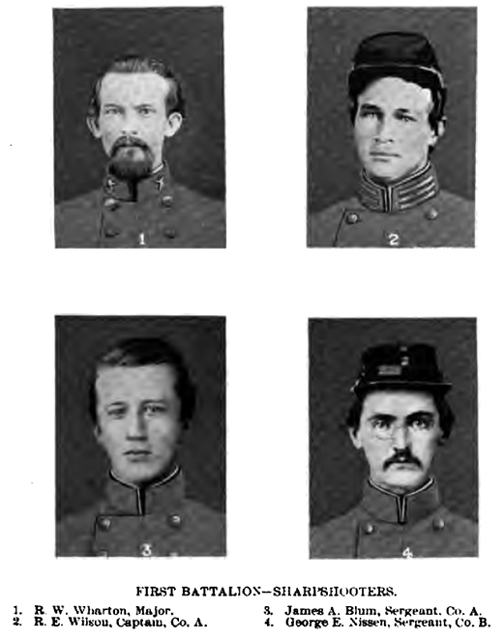
[Company A was formerly Company B in the 11th NC Volunteers, and transferred to this Battalion on April 26, 1862. Company B was formerly Company E in in the 11th NC Volunteers, and transferred to this Battalion on April 26, 1862.] This battalion was organized on April 26, 1862, and was composed of two (2) companies from the 11th NC Volunteers, which became the 21st NC Regiment also on April 26, 1862. That regiment originally had twelve (12) companies. At its
re-organization on April 26, 1862, the two (2) companies commanded,
originally, by Capt. John K. Connally and Capt. Rufus W. Wharton,
were organized into a battalion, Rufus W. Wharton with the rank
of Major Commanding. Capt. Connally having previously resigned,
Company A, of the battalion, was then commanded The history of the 11th NC Volunteers is the history of the two (2) companies composing the battalion during the first year of the war. The 11th NC Volunteers, though composed entirely of North Carolina troops, was organized at Danville, VA, on June 18, 1861, where it remained about three (3) weeks, engaged in company and battalion drill. It went thence to Richmond, VA, and stopping there four or five (4-5) days, proceeded by railroad, towards Winchester, VA, to join General Joseph E. Johnston (VA). When the regiment arrived at Manassas Junction, about sundown on July 16th, it was ordered to remain on board the cars and await further orders. MANASSAS. At daybreak next morning it was ordered to leave the train and proceed immediately to Mitchell's Ford, on Bull Run. Mitchell's Ford is on the direct road from Manassas Junction to Centreville, about halfway between the two (2) places, and about four (4) miles from each. Centreville lies north of the junction, and had been occupied by the enemy under Brig. Gen. Irvin McDowell on the preceding day, and it was expected that he would attempt to capture the junction that day, July 17th. The regiment reported to Brig. Gen. Milledge L. Bonham (SC), at Mitchell's Ford, and was posted by him on the extreme left of his brigade, about half a mile from the ford. While going to this position the regiment was under fire for the first time. While passing through an old field, the enemy fired a few shots and shells in our direction. Some of the shells exploded quite near us, sounding decidedly ugly and causing a general disposition to duck one's head. The fight on that day was only an artillery duel, with but little damage on either side. No one in the 11th NC Volunteers was hurt. That night the 11th NC Volunteers was posted at the ford, occupying several hundred yards on each side of the same and remained in that position up to and during the battle of Sunday, July 21st. Early on the morning of July 21st the enemy opened fire on our position with artillery and kept it up for several hours. The shot were aimed too high, however, and again no one in the regiment was hurt. At first the men were quite nervous, but that soon passed off and when later in the day the 11th NC Volunteers was ordered to march on Centreville, a shout went up from one end to the other of the regiment and in ten (10) minutes time it had fallen into line, waded the creek and was on the Centreville side ready for any service required. From some mis-management, not, however, on the part of the commanding officer of the 11th NC Volunteers, but of the commander of the brigade, nothing was accomplished under this order. After the battle, the 11th NC Volunteers remained in the vicinity of Manassas for several weeks, and from bad water and the general unhealthiness of the country there was much sickness among the men and ofiicers. Camp was next moved to a point near Groveton on the Manassas Gap Railroad and about eight (8) miles west of the junction. The change of camp seemed to do no good and in a short time there were between seven and eight hundred (700-800) sick men in camp. Diarrhea and Camp Fever were the prevailing diseases. During the six or seven (6-7) weeks which the regiment spent in this camp, one hundred and sixty-four (164) of its members died in camp and neighboring houses. From some cause the loss of the two (2) companies, that afterward formed the battalion, were less than half of that of any other two (2) companies in the regiment. From here the regiment went to Bull Run Gap, the point where the railroad passes through the Bull Run Mountains. In the latter part of October most of the men, who had survived, were again able for service and the regiment then about 800 strong, moved down to Centreville, where, for some time, a battle seemed imminent. Soon after Christmas, the 11th NC Volunteers went into winter quarters on the railroad between Manassas and Bull Run. On March 8, 1862, the 11th NC Volunteers, with the balance of the army, left Manassas Junction and fell back to the south bank of the Rappahannock River. The 11th NC Volunteers was then a part of Maj. Gen. Richard S. Ewell's (VA) Division, which remained in the vicinity of Rappahannock Station until April, when it moved back to Gordonsville and from there moved over into the Valley of Virginia and united with the forces under Maj. Gen. Thomas J. "Stonewall" Jackson (VA). BATTALION ORGANIZED. On the march to the Valley of Virginia, the division halted for two or three (2-3) days near Gordonsville. During that halt the 1st NC Battalion - Sharpshooters was organized on April 26, 1862, though the two (2) companies composing it remained a part of the now 21st NC Regiment (was the 11th NC Volunteers) until after the battle of 1st Winchester, VA, on May 25, 1862. It was in that fight the 21st NC Regiment had its real baptism of blood on the field of battle. In that fight every third man of the regiment that went in was killed or wounded in twenty (20) minutes. Maj. Gen. Thomas J. "Stonewall" Jackson (VA), with Brig. Gen. Richard Taylor's Brigade of Louisianians, approached Winchester by the Valley Turnpike, while Maj. Gen. Richard S. Ewell (VA), with Brig. Gen. Isaac R. Trimble's (VA) Brigade, and one or two (1-2) batteries, approached by the plank road from Port Royal. Shortly before night, on the evening of May 24th, Brig. Gen. Trimble's Brigade, with the 21st NC Regiment in front, came upon the enemy's picket, some three (3) miles out from the town. The picket was soon driven in and the troops advanced until they were about a mile and a half from Winchester. Soon after dark the writer was ordered to proceed with his own and another company to a skirt of woods on the left of the road and about a mile from town. It was expected that we would find the woods occupied by the enemy's skirmishers. We were to drive them out of the woods and hold the same until further orders. We found no one in the woods, but the enemy had left evidence of having recently been there. WINCHESTER. At daylight on May 25, 1862, Col. William W. Kirkland came up with eight (8) companies of the 21st NC Regiment, ordered the writer to call in his two (2) companies and join the regiment and immediately proceeded down the road toward town at a double-quick. Just at the edge of the town, where the land was cut up into small parcels, surrounded by stone walls and without any warning a whole brigade of Yankees rose up from behind a stone wall on our left and less than seventy-five (75) yards from the road on which the regiment was marching, and poured a deadly fire into our ranks. Col. Kirkland ordered a charge; some of the men got to the wall behind which the enemy were, but none got over it. We then fell back behind a wall that ran along side the road on which we had been marching and kept up the fight until the enemy's line, which was much longer than ours, extended around on our side so as to subject us to a flank as well as front fire. The regiment was then moved about a hundred (100) yards to the left, in order to protect its right flank and formed with a view of making another attack on the enemy's position, but not in front of the stone wall this time. Our intention was to make a short detour and get on both sides of the enemy's wall and attack them on the flank. The men were thoroughly aroused and had no idea of giving up the job until they had driven the enemy from its position. At this juncture orders came to desist from making a further attack, as troops were being sent to the rear of the town to intercept the retreat of the enemy. About this time Maj. Saunders F. Fulton, with the two (2) other companies, came up and rejoined the regiment. The Major with two (2) companies had been sent out the previous night into another part of the field and had not gotten back when the fight began. We were then ordered to protect Latta's Battery, which was on a hill not far away. The order was given by Maj. Gen. Richard S. Ewell (VA) in person, and was very emphatic. We were told to go with the battery wherever it went and not to leave it under any circumstances. In a short time the battery moved off briskly to and through the town. We followed at a double-quick. When we reached the main street, we found it full of the citizens —old men, ladies, and children, who had turned out to feed the Confederate soldiers. Some had pitchers of water, others had plates and trays of bread and chicken and ham and all kinds of good things to eat. As the writer was passing along, a very beautiful young girl gave him a glass of water, at the same time a fine looking old gentleman seized him by the arm, saying come in here, opening a door. I was led up to a side board and commanded to take something. While I was "taking something" in came the good lady of the house with fried chicken and bread. I had no time to stop and eat, but taking my hands full of the good things, I put out after that battery. We followed it all that day. Some times we were in sight of it and some times not. On reaching Bunker Hill, twelve (12) miles below Winchester on the road to Martinsburg, we decided to halt for the night and give the stragglers time to come up. These continued to come in for two or three (2-3) hours and it was noticed that most of them had something that was not water in their canteens. We were on the road again, next morning, as soon as it was light and soon overtook the battery and marched into Martinsburg with the battery and Col. Turner Ashby's (VA) Cavalry, about 10 a.m. In a little more than twenty-four (24) hours we had fought a severe battle and marched twenty-two (22) miles in pursuit of the enemy. The 21st NC Regiment went into the fight with about 300 men, the Major and two (2) large companies being absent. Of these 104 were killed or wounded. Col. William W. Kirkland was severely wounded early in the fight; Lt. Col. Rufus K. Pepper had wounds from which he died in a few days; Capt. Jacob D. Hedgecock was mortally wounded, and Capt. Hiram S. Ligon was killed in the charge on the stone wall. While we, with Latta's Battery and Col. Ashby's Cavalry, were in hot pursuit of Maj. Gen. Nathaniel P. Banks, we supposed that the balance of the brigade was coming on, but more leisurely. Finding, however, that it did not come up, we reported to Col. Turner Ashby (VA), the ranking officer present and who a day or two afterwards was promoted to Brigadier General. Col. Ashby said he had not expected any infantry, but directed us to go into camp and await further orders. Next day he informed us that he had received a dispatch from Brig. Gen. Isaac R. Trimble (VA) inquiring if we were at Martinsburg and stating that it had not been intended that we should follow the battery there, but only that we should stay by it during the balance of the fight at Winchester. We, however, understood and obeyed the order of Maj. Gen. Richard S. Ewell (VA) literally and were well repaid for our hard march. We found Martinsburg full of sutler's stores that had been hastily abandoned. The railroad depot was also crowded with choice commissary supplies and hundreds of boxes of nice things that had been sent out to the Federal officers and soldiers by their friends at home. Every soldier that wanted a box took one. One of them opened his box in the presence of the writer. It contained a dozen bottles of claret, at which he was much disappointed. After the battle at Winchester the two (2) companies that composed the 1st NC Battalion-Sharpshooters was detached from the 21st NC Regiment and became a separate command. We remained at Martinsburg five or six (5-6) days and then rejoined the brigade near Winchester. On reaching Strasburg, twelve (12) miles southwest of Winchester, we left the turnpike and took a road leading in a northwest direction. After marching about two (2) miles we encountered the head of Federal Maj. Gen. John C. Fremont's column. Maj. Gen. Fremont, with 25,000 men, was coming down from northwest Virginia to intercept and capture Maj. Gen. Thomas J. "Stonewall" Jackson (VA) with his little army of 14,000 men. Maj. Gen. Jackson, however, as was his custom, got to the right place first. The Confederates were quickly formed into line of battle and after a little skirmishing and a big demonstration, were quietly withdrawn and reformed in line on the high ridge just west of Strasburg, where we remained until after dark. As soon as it was fully dark we quietly withdrew and made a rapid march in the direction of Woodstock. We marched until 2 a.m. that night. After that we proceeded up the Valley at our leisure and were not molested by the enemy until after we left the turnpike and were on the road to Port Republic. Next morning after leaving the turnpike the enemy's cavalry attacked our rear at Good's Farm (aka Harrisonburg) which was in charge of Brig. Gen. Turner Ashby (VA). The attack was quickly repulsed and some prisoners captured. The writer saw the prisoners a few minutes after their capture. Among them was a large fine looking officer of the rank of Colonel and in full Federal uniform. This officer proved to be Percy Wyndham, an Englishman and soldier of fortune, who commanded a brigade of Maj. Gen. Fremont's Cavalry. After repulsing the attack Brig. Gen. Ashby pursued the attacking force and made an attack upon it, after it had been reinforced by infantry. In this attack he was killed. His death was a serious loss to Maj. Gen. Jackson's command. He was not only a gallant and enterprising officer, but also an exceedingly attractive man. The writer had been under his command a short time at Martinsburg and had seen considerable of him. The next day was Sunday, a bright, balmy, pure day. About the middle of the afternoon we halted and went into camp near a place called Cross Keys, which was only a crossroad and a small church building or school house, about one and a half miles from Port Republic. All were glad to have a little rest. CROSS KEYS. The next day was June 8th. Everything was very quiet in camp, during the morning; no marching orders were read and the general impression was that we were to have a whole day's rest. This impression did not last long. Brig. Gen. Isaac R. Trimble (VA) ordered the battalion to go back, on the road by which we came, about a mile, and take possession of a skirt of woods between two (2) fields, on the right of the road, and to hold the same until he came up with the balance of the brigade. The order was promptly executed and as soon as the brigade was in sight, the battalion, deployed as skirmishers, was advanced across the field in front. The field was in wheat just headed out. The enemy soon made their appearance in force. The skirmishers fell back to the brigade, which was quietly lying behind a rail fence, which ran along the edge of the field in front. Soon the enemy came up briskly, in line of battle, with no skirmishers in advance. When they were within sixty or seventy (60-70) yards of the fence the brigade rose up, fired, and then charged. The enemy broke and fied precipitately to a wood beyond the field, leaving, however, some 200 dead and wounded. The brigade after pursuing a short distance returned to its first position. The field in front was only about a third of a mile wide and we could plainly see the maneuvers of the enemy, and that heavy reinforcements were coming up. Soon they formed another line of battle and began to advance across the field. Our orders were to remain perfectly quiet, withholding our fire until they were within short range and then let them have it. Unfortunately, however, one man in the 15th Alabama could not resist the temptation to shoot and fired before they had advanced fifty (50) yards and then the whole of the regiment fired. The enemy hastily fell back into the woods and did not again attempt to advance. Later in the day we attacked them simultaneously in front and on their left flank and drove them back a mile or more. This ended the fight on our right wing. When the fight ended the whole field of battle was in our possession and the enemy had been driven back fully a mile and a half. That night the battalion was posted in the woods where the fight began. The moon shone brightly and I walked out where some of the enemy's dead and wounded were still lying. As I walked along the wounded would speak to me. I could not understand what they said. Finally one of them in broken English said they were asking me to have them removed to the hospital. They were all Germans and I learned that some of them had been in America only a few weeks. In a short time the ambulances came up and removed the poor fellows who were paying dearly for the greenbacks, for which only, they were fighting. PORT REPUBLIC. Early next morning we crossed the river at Port Republic, the battalion bringing up the rear and being the last to cross the bridge. Two or three hundred (200-300) yards before reaching the bridge we passed a straw stack, when each man was required to take up a bunch of straw and drop the same on the bridge. After the battalion had crossed the straw was fired and in a few minutes the whole bridge was in flames. After the bridge had been fired a single Confederate cavalryman came up to cross. Seeing the bridge was on fire, he attempted to swim his horse across the river, which was fiush and the current strong. In the middle of the river the horse became confused and both horse and rider disappeared under the water and were seen no more. While this was going on, the hard fought and bloody battle of Port Republic was being fought —about two (2) miles below the village. During the night Maj. Gen. Thomas J. "Stonewall" Jackson (VA), leaving Brig. Gen. Isaac R. Trimble (VA), with his brigade, to face Maj. Gen. John C. Fremont and retard his advance, had moved the greater part of his forces to the south side of the river and early in the morning met and defeated Brig. Gen. James Shields, whose forces, it was said, amounted to about 12,000. The battle was, for a short time, stubborn and very bloody—but was over before Brig. Gen. Trimble's Brigade arrived on the ground, and Brig Gen. Shields was in full retreat. After this we encamped on the Shenandoah River, near Weir's Cave, and had a much needed rest of about two (2) weeks. Our next move was southeastward across the Blue Ridge Mountains, through Charlottesville and Gordonsville and on towards Richmond. BATTLES AROUND RICHMOND. In about six (6) days we arrived at Ashland, some sixteen or eighteen (16-18) miles from Richmond. Next day the Seven Days' Battles commenced. That night we lay not far in the rear of Federal Maj. Gen. George B. McClellan's right wing. We were near enough to hear the report of small arms. The battalion did picket duty that night. Next day we soon fell in with the divisions of Maj. Gen. Daniel H. Hill (NC) and Maj. Gen. A. P. Hill (VA), and when it was known that we were Maj. Gen. Thomas J. "Stonewall" Jackson's (VA) troops from the Valley, were greeted with shouts of applause. All the roads were full of marching troops. Every now and then a shout would be heard in front or rear, and pass along the line in our direction. The men would immediately say that Maj. Gen. Jackson, or more frequently, "Old Jack," as they familiarly and affectionately called him, was coming. In a few minutes Maj. Gen. Jackson and his staff would pass. Maj. Gen. Jackson's Corps marched in the rear that day and of course our progress was slow. About the middle of the afternoon we heard firing not very far in our front. Brig. Gen. Isaac R. Trimble (VA) took his brigade, by a shortcut, through some fields, and in a short time we were on the field of the first battle of Gaines's Mill or 1st Cold Harbor. Brig. Gen. Trimble's Brigade was composed of the 15th AL, 16th MS, 21st GA, 21st NC Regiments, and the 1st NC Battalion-Sharpshooters. In this battle the Georgia and Alabama Regiments were soon engaged. The Mississippians and North Carolinians were held in reserve until near the close of the fight. Shortly before sundown, an officer rode up to Brig. Gen. Isaac R. Trimble (VA), who was sitting on his horse near where I was and said, "General Trimble, General Lee says the enemy have been driven on both flanks, but still holds his position in that woods," pointing towards a piece of woodland about a quarter of a mile distant. "He directs you to drive them from it." We were ordered to charge as soon as we came in sight of the enemy. On reaching the woods we first went down a steep hill, crossed a branch, and then up a steep hill. When we got to the top of the hill we saw the enemy about 100 yards in front, but there was another branch between us and them. We immediately raised the rebel yell and charged. The enemy fired as soon as we came in sight, stood their ground, and fired again before we got to them. When we were within a few yards of them they gave way. In this charge a few men in the battalion were wounded, but none killed. Doubtless if we had stopped to fire when we came in sight of the enemy, the casualties on our side would have been much greater. Just in the rear of the captured position were hundreds of
standing tents. In one of these tents Lt. Col. Saunders F. Fulton,
of the 21st NC Regiment, found a wounded Federal Lieutenant who,
upon inquiry, turned out to be a member of a Pennsylvania Regiment
and a distant relative of his. Next day, Maj. Gen. Jackson with
his Corps marched eastward to a point on the Richmond & Yorktown
Railroad, to intercept the enemy in case he should attempt to
retreat by that route. Nothing of special interest occurred until
about the middle of the afternoon, when suddenly we heard a tremendous
noise up the road, which sounded like the near approach of a
great storm and instantly a train came rushing down the road
at a fearful speed and pitched into a small creek where a bridge
had been CEDAR MOUNTAIN AND SECOND MANASSAS. After the Seven Days' Battles were over the battalion remained in the vicinity of Richmond three or four (3-4) days and was then, with the rest of the brigade, hurried back to Gordonsville to protect that place from a raid. We encamped near Gordonsville several weeks. The next fight was that of Cedar Mountain (aka Cedar Run), in which the battalion participated. It was also in Maj. Gen. Thomas J. "Stonewall" Jackson's (VA) raid on Manassas Junction and in all the hard fighting done by Maj. Gen. Jackson's troops in the battle of 2nd Manassas. The battalion suffered heavily in the latter fight. Capt. Reuben E. Wilson, of Company A, was severely wounded; 3rd Lt. William L. Owen, of Company B, was killed. Eight or nine (8-9) others were killed and quite a number wounded. The battalion was also at the capture of Harper's Ferry, and the battle of Sharpsburg, sometimes called Antietam. FREDERICKSBURG. The battalion remained in northern Virginia until the middle of November and then moved down to Fredericksburg in time for the battle of December 13, 1862. In the beginning of that battle our position was in the second line, near Hamilton's Crossing, on the railroad. We were directly in the rear of one of our batteries which was hotly engaged with the enemy, the enemy's shot and shell passing over us, at first fifteen or twenty (15-20) feet above our heads. Their aim was soon lowered and we were compelled to lie flat on the ground to avoid being hit. One solid shot passed between the writer and the man lying next to him, and the Adjutant of the 21st NC Regiment, who was lying a few feet away, was instantly killed by a solid shot striking the ground directly under him. Under such circumstances the order to advance was a welcome one. The enemy had broken our first line in our front. We soon drove them back and advanced some distance beyond the railroad. This position being much exposed we fell back to the railroad cut, in which we remained during the night. Many of our dead foes, and among them Brig. Gen. Conrad F. Jackson, who that day commanded a brigade of Pennsylvanians, called Buck Tails, because each man wore a wisp of a buck's tail in his cap, were lying near us and some of our men who had worn out their shoes in the march from the Valley took the opportunity to get a new supply. In this fight the battalion had some wounded, but none killed. After the fight was over and Federal Maj. Gen. Ambrose E. Burnside had got back to the north side of the river, the battalion with the rest of the brigade went into winter quarters on the Rappahannock River, sixteen (16) miles below Fredericksburg. At this time our rations were small in quantity and poor in quality. Poor beef, corn meal, and flour, and not enough of that, constituted the bill of fare. There were thousands of ducks on the river, almost every day, and it was agreed that Capt. Adams, Adjutant General of the brigade, and the writer should make an effort to bag some of them. We made the effort and the result was, got ourselves bagged. We borrowed a double-barreled shotgun from a man living near our camp and went duck hunting. The river at that point, Port Royal, is about 500 yards wide and was picketed on the south side by Confederates and on the north by Federal cavalry. The pickets did not molest each other nor any one out on the river. CAPTURED. While we were out a heavy wind storm came up from the south, blowing directly across the river, and in spite of all we could do, boat and duck hunters were blown over to the north side and picked up by the Yankee pickets. We were treated very well, however, by our captors, and were sent up to Maj. Gen. Ambrose E. Burnside and thence to Washington City to spend the winter in the Old Capitol Prison. We were exchanged and got back to the Confederacy in time for the next fight, the battle of Chancellorsville. During this fight the battalion was in Maj. Gen. Jubal A. Early's (VA) Division and was engaged more or less on the skirmish line or in line of battle, from Thursday morning until the next Monday morning, when the last of the enemy, not killed or captured, succeeded in getting back to the north side of the Rappahannock River. In the Sunday evening fight, Maj. Gen. Early's Division charged and drove the enemy from a strong position. Brig. Gen. Robert F. Hoke (NC) was severely wounded and his brigade suffered severely, especially in officers. In the battalion a number of men were wounded, but not killed outright. GETTYSBURG CAMPAIGN. The next move was that which culminated in the battle of Gettysburg. Lt. Gen. Richard S. Ewell (VA) had assumed command of the deceased Lt. Gen. Thomas J. "Stonewall" Jackson's Corps, and, though he had lost a leg at the battle of 2nd Manassas, could still mount and ride a horse quite well. At the beginning of the campaign the battalion was detached from Brig. Gen. Robert F. Hoke's (NC) Brigade —then commanded by Col. Isaac E. Avery, of the 6th NC Regiment, and ordered to report directly to Lt. Gen. Ewell. The march into and through Pennsylvania was delightful, at least until the time when the Corps left Carlisle. The country was magnificent and full of all needed supplies, except certain articles which our soldiers especially needed, such as hats, shoes, etc. These articles had been shipped away or concealed so that we did not find them. The writer was Military Governor of Carlisle for nearly two (2) days and the only thing that he got for governing and taking care of the city during that time was one glass of beer. When the Corps left Carlisle the battalion had orders to wait until all the other Confederates were out of the city and then bring up the rear. We left just before daybreak and as we were on the point of marching, several hundred Federal prisoners were turned over to us by our cavalry. The prisoners were Pennsylvania militia that had been called out to repel our invasion. What to do with them was the question. I had no idea of being encumbered with such a large lot of inoffensive people. The late Col. D. M. Carter, then a member of the military court of Lt. Gen. Ewell's Corps, who was with me, concluded that the best thing to do was to parole them and let them go home. After some trouble we got them into a long line, single file, and requiring every man to hold up his right hand, administered to them, en masse, an oath that they would not take up any arms against the Confederacy again until they had been regularly exchanged. They evidently took the oath willingly. The streets of Carlisle were macadamized and consequently were full of small pebbles and stones. The moon was shining brightly and I observed that the prisoners moved about very gingerly, but did not know the cause until happening to look down I saw that the last one of them was barefooted. The scene was extremely ludicrous. The battalion had nothing to do with the matter. The prisoners were just as we received them. Possibly they exchanged their shoes for tobacco, as was sometimes done down in Virginia, or possibly their captors may have taken their shoes from them, as a punishment for sending out of our reach all the shoes that should have been in the stores. From Carlisle we marched in the direction of Gettysburg and when near that place the battalion was ordered by Lt. Gen. Ewell, to Cashtown, a small village some three (3) miles from Gettysburg, to guard his train and protect it from Federal cavalry. Next day the train was moved to the right and to a point immediately in the rear of Lt. Gen. James Longstreet's (VA) Corps. On the morning of July 3rd, hearing that there was Federal cavalry a short distance in our rear, Col. D. M. Carter and the writer rode back a mile or two to reconnoiter. We found that the cavalry had been in the vicinity, but were gone. Returning, and just as we reached the top of a high hill and about a mile and a half in rear of our army, the artillery fire of that day opened. In a few minutes a large number of guns were at work. It was reported that about 140 guns on each side were firing at the same time. The scene was grand as well as terrible and was far beyond anything that I had witnessed before, though I was at Malvern Hill and most of the other great battles in Virginia. We sat on our horses for some time and witnessed the terrible conflict. Afterwards, when the infantry got to work, we went up into the immediate rear of the fight, where the wounded were being collected. It had then begun to rain and for most of the wounded there was no shelter. THE RETREAT FROM GETTYSBURG. Next morning, July 4th, Lt. Gen. Richard S. Ewell (VA) ordered the 1st NC Battalion-Sharpshooters to escort his train back to Williamsport, on the Potomac River, and sent a company of Alabamians, commanded by a Lieutenant, and containing about thirty (30) men, to reinforce it. The Alabamians were placed in front, and my battalion brought up the rear. The train contained more than a hundred (100) wagons and ambulances, and when strung out on the road extended over several miles. Our route, after passing through a valley for several miles, led up a mountainside by a narrow, rough road to the Gettysburg and Hagerstown Turnpike. Soon after we started an exceedingly heavy rain fell which rendered travel slow and difficult. At the junction of our road with the turnpike a considerable force of our cavalry had been previously stationed, as an attack on that point by the enemy's cavalry was apprehended. During the afternoon we occasionally heard a few shots on top of the mountain, and as night approached the firing became frequent. We also learned from couriers who came down the mountain that a heavy force of Federal cavalry was threatening that position. With my battalion were a few Federal prisoners, and also forty or fifty (40-50) Confederates under arrest for various minor offenses during the campaign. In addition to these were four (4) Confederates under sentence of death for desertion, and were under a separate guard. Just before night I released and armed all the Confederate prisoners except the four (4) under sentence, and ordered them to fall in with my battalion, telling them if they behaved well that night I would report the same in their behalf. After nightfall the firing on top of the mountain greatly increased. Taking my battalion and the men who had just been released from arrest, I proceeded up the mountain, halting the train as I passed, to the assistance of our friends at the junction of our road with the turnpike. Before reaching the point the firing became very heavy for a few minutes and then ceased and was followed by the huzzas of the enemy. By this we knew the position had been captured by them and that they would break into that part of the train that had passed that point. We went ahead as fast as we could and as we came near found the enemy had placed a cannon in the road by which we were approaching and were firing grape shot down the same every few minutes. Fortunately, the road made a sharp turn, about 100 yards from the gun and the shot did not sweep the road beyond that point. After a sharp engagement we captured the position together with fifteen or twenty (15-20) prisoners. Among the prisoners was an elderly gentleman named Mitchell, who was Army Correspondent of the New York Herald. We also captured the colored servant of Maj. Gen. Hugh J. Kilpatrick and three (3) of the general's saddle horses. The enemy captured and carried off a few of our wagons and ambulances and doubtless, but for our timely arrival and attack, would have destroyed a large part of the train. The Confederates that I had released and armed a few hours before behaved well and a number of them, who belonged to the cavalry, mounted themselves on the horses captured that night. A very remarkable thing occurred next morning in rear of the train. While my battalion was engaged in the fight, some Confederate cavalry that arrived at the point of attack at the same time as the battalion stampeded and rushing down the mountain in great disorder completely dispersed the guards in charge of the prisoners in rear of the train. It was a very dark and rainy night. They were in a dense woods. It was impossible to recognize anyone and no attempt was made to collect the prisoners until next morning. After daylight three (3) of the four (4) Confederate soldiers that were under sentence of death, reported to the officer of the guard and all the Federal prisoners were found nearby. Of course after that the three (3) Confederates were pardoned. We remained on the north side of the Potomac River, near Williamsport, about a week and then returned to Virginia with the rest of the army. A few weeks thereafter my battalion was sent back to our old brigade, again commanded by Brig. Gen. Robert F. Hoke (NC), who had recovered from the wound received in the battle of Chancellorsville. IN NORTH CAROLINA. Nothing of special interest occurred in Virginia in the Fall of 1863. In February of 1864, the battalion was in the New Bern expedition under Maj. Gen. George E. Pickett (VA). In an attempt to capture the bridge across Bachelor's Creek, near New Bern, by a detail of twenty (20) men under Capt. John A. Cooper, now a resident of Statesville, NC, three (3) men were killed outright on the bridge and a number severely wounded. Among the killed was Corporal Henry N. Welsh, who deserves special notice. He was a native of Davidson County and one of the original members of Company B. When he volunteered he was a delicate looking young man and it was not thought that he would be able to stand the service long. After an attack of fever the first summer he enjoyed good health and was conspicuous for the fidelity and promptness with which he discharged all his duties. When a detail was called for, on service considered especially dangerous, he was the first or among the first to step out. He had been in the service from 1st Manassas to this time, February 1, 1864, and had never had a furlough, but under the furlough system of the Army of Northern Virginia was then entitled to one, but had deferred taking it until this expedition was over. He was shot in the head and instantly killed on the bridge across Bachelor's Creek. We sent the lifeless body of this youngest child and darling home to loving parents. His noble and gallant spirit had received a furlough for all eternity. The 1st NC Battalion-Sharpshooters remained in North Carolina the balance of the Winter and Spring of 1864, and was in the expedition under Brig. Gen. Robert F. Hoke (NC), which captured Plymouth, NC on April 20, 1864. On January 18, 1864, the writer was appointed, by Governor Zebulon B. Vance, Lieutenant Colonel of the 67th NC Regiment, which position he assumed in February after the New Bern expedition. He is, consequently, unable to give a detailed account of the services of the battalion after that date. PETERSBURG. The battalion returned to Virginia and participated in the defense of Petersburg, being attached to Brig. Gen. Robert D. Johnston's (NC) Brigade, Maj. Gen. Jubal A. Early's (VA) Division, 96 Official Records of the Union and Confederate Armies, pp. 1180 and 1270. It surrendered at Appomattox with that division, the battalion being then commanded by 1st Lt. Robert W. Woodruff. 95 Official Records of the Union and Confederate Armies, p. 1270. In one of the last engagements near Petersburg, Capt. Reuben E. Wilson lost a leg; 1st Lt. Cornelius A. Shultz lost an arm and 3rd Lt. William L. Masten was killed. During the last six (6) months of the war Capt. John A. Cooper served on the staff of Maj. Gen. Robert F. Hoke (NC). I learn from a statement sent me by Mr. Thomas B. Douthit, of Salem, who was one of the original Privates of Company B, and served through the entire war, that in that company eleven (11) men were killed outright in battle, eighteen (18) were severely wounded, some of them entirely disabled for further service, and seventeen (17) died of disease. I have no information of the exact number of casualties in Company A, but presume that they were about the same as in the other company. Rufus W. Wharton, * The above was written by former Major Rufus W. Wharton on April 9, 1901, and provided as Pages 225-242, in the compilation known as "Histories of the Several Regiments and Battalions from North Carolina in the Great War 1861-'65 - Volume IV," edited by Walter Clark, and published by E. M. Uzzell, Printer and Binder, in 1901. Minor edits, additions, and deletions were provided by this Author for clarity and consistency. Summarized from "North Carolina Troops: 1861-1865, A Roster, Volume III, Infantry," Page 68: When Maj. Gen. Robert F. Hoke (NC) was recalled to Virginia after taking Plymouth, the 1st NC Battalion-Sharpshooters were apparently left behind in North Carolina. They were assigned Provost Guard duty in Kinston. On September 6th, they were ordered to Weldon, NC to be posted at the different fords along the Roanoke River, west of Weldon to Clarksville, VA. On October 1st, the battalion was ordered to New Market, VA and assigned to Brig. Gen. Robert D. Johnston's (NC) brigade, in which the remained until the end of the war. They remained in camp until November 10th, then ordered again towards Winchester, VA. They returned to New Market on November 17th, then to Lacy Springs, VA until December 6th. Then to Waynesboro on December 7th until the 10th. Then by railroad to Petersburg. Brig. Gen. Robert D. Johnston's (NC) brigade took part in the engagement at Dabney's Mill (aka Hatcher's Run) on February 5-7, 1865, then at Hare's Hill (aka Fort Stedman) on March 25, 1865. When Petersburg was evacuated on April 2, 1865, the 1st NC Battalion-Sharpshooters was led by 1st Lt. Richard W. Woodruff, and what was left surrendered at Appomattox, VA on April 9, 1865. |
||||
|
|
||||
|
|
|
|||
|
|
|
|||
|
|
|
|||
|
|
|
|||
|
|
|
|||
|
|
|
|||
|
|
|
|||
|
|
|
|||
|
|
|
|||
|
|
|
|||
|
|
|
|||
|
|
|
|||
|
|
|
|||
|
|
|
|||
|
|
|
|||
|
|
|
|||
|
|
|
|||
|
|
|
|||
|
|
|
|||
|
|
|
|||
|
|
|
|||
|
|
|
|||
|
|
|
|||
|
|
|
|||
|
|
|
|||
 |
 |
© 2022 - J.D. Lewis - PO Box 1188 - Little River, SC 29566 - All Rights Reserved